ĐỪNG BỎ LỠ các mẫu laptop giá tốt giúp học tiếng Anh dễ dàng hơn:
IELTS Writing Task 1 không khó nếu bạn nắm vững quy trình và bố cục chuẩn. Bài viết này hướng dẫn cách viết IELTS Writing Task 1 theo cách dễ áp dụng nhất từ khâu phân tích đề, tìm đặc điểm chính (key features), cho đến cách triển khai 4 đoạn văn logic để ghi điểm tuyệt đối. Xem ngay!
1. IELTS Writing Task 1 là gì và yêu cầu những gì?
Định nghĩa và vai trò
IELTS Writing Task 1 là phần đầu tiên của bài thi Writing Academic. Bạn cần viết một bản báo cáo (report) tối thiểu 150 từ để mô tả dữ liệu trực quan (biểu đồ, bản đồ, quy trình) trong khoảng 20 phút.
Khác với Task 2, Task 1 yêu cầu sự khách quan tuyệt đối chỉ mô tả, tóm tắt và so sánh dữ liệu hiện có, không nêu quan điểm cá nhân hay giải thích nguyên nhân nằm ngoài biểu đồ.
5 yêu cầu nền tảng để đạt điểm cao
- Độ dài tối thiểu 150 từ (vùng an toàn là 160 - 190 từ).
- Hoàn thành trong khoảng thời gian lý tưởng: 20 phút.
- Summarize information: Tóm tắt được các thông tin tổng quát nhất.
- Report main features: Nêu bật được các đặc điểm quan trọng (số liệu cao/thấp nhất, xu hướng chính).
- Make comparisons: Biết cách so sánh các nhóm dữ liệu có liên quan để làm nổi bật sự khác biệt.
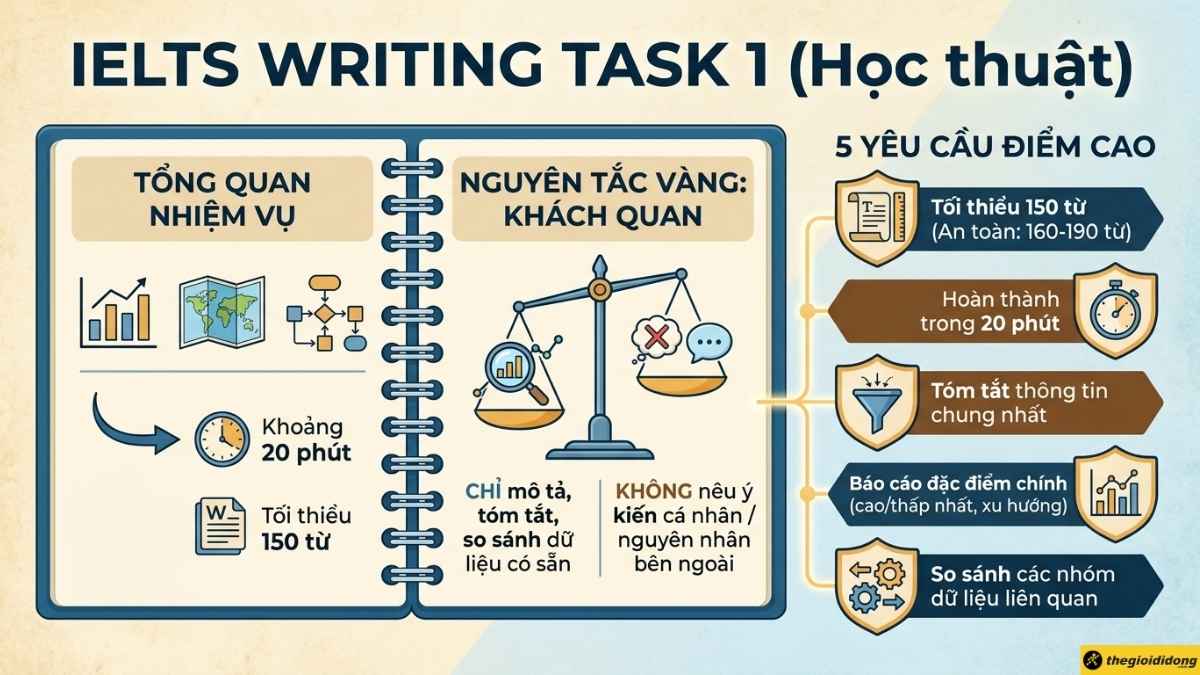
5 yêu cầu nền tảng để đạt điểm cao
Lỗi thường gặp: Viết theo kiểu liệt kê mọi số liệu có trong biểu đồ theo thứ tự từ trên xuống dưới hoặc đưa các nhận xét chủ quan như "số liệu này cho thấy nền kinh tế đang tốt lên".
2. Các dạng đề thường gặp trong Task 1
Kỹ năng quan trọng nhất trong Task 1 là data interpretation (kỹ năng hiểu và giải thích dữ liệu). Có 7 dạng đề chính bạn cần lưu ý:
|
Dạng bài
|
Mục tiêu mô tả
|
Lỗi người mới hay gặp
|
|
Line graph
|
Sự thay đổi, xu hướng theo thời gian.
|
Mô tả từng năm riêng lẻ, không nhóm giai đoạn.
|
|
Bar chart
|
So sánh các hạng mục tại một hoặc nhiều mốc thời gian.
|
Liệt kê số liệu từng cột, thiếu tính so sánh.
|
|
Pie chart
|
Tỷ trọng, phần trăm của các thành phần trong một tổng thể.
|
Dùng từ tăng/giảm cho biểu đồ không có yếu tố thời gian.
|
|
Table
|
Bảng số liệu chi tiết.
|
Bị rối dữ liệu, cố gắng đưa mọi con số vào bài.
|
|
Process
|
Quy trình sản xuất hoặc chu trình tự nhiên.
|
Thiếu các từ nối chỉ trình tự (First, Next, Finally).
|
|
Map
|
Sự thay đổi của một khu vực qua các thời kỳ.
|
Sử dụng sai từ vựng về phương hướng và không gian.
|
|
Mixed charts
|
Kết hợp nhiều loại biểu đồ (ví dụ: Table + Pie).
|
Viết rời rạc, không tìm thấy mối liên hệ giữa hai biểu đồ.
|
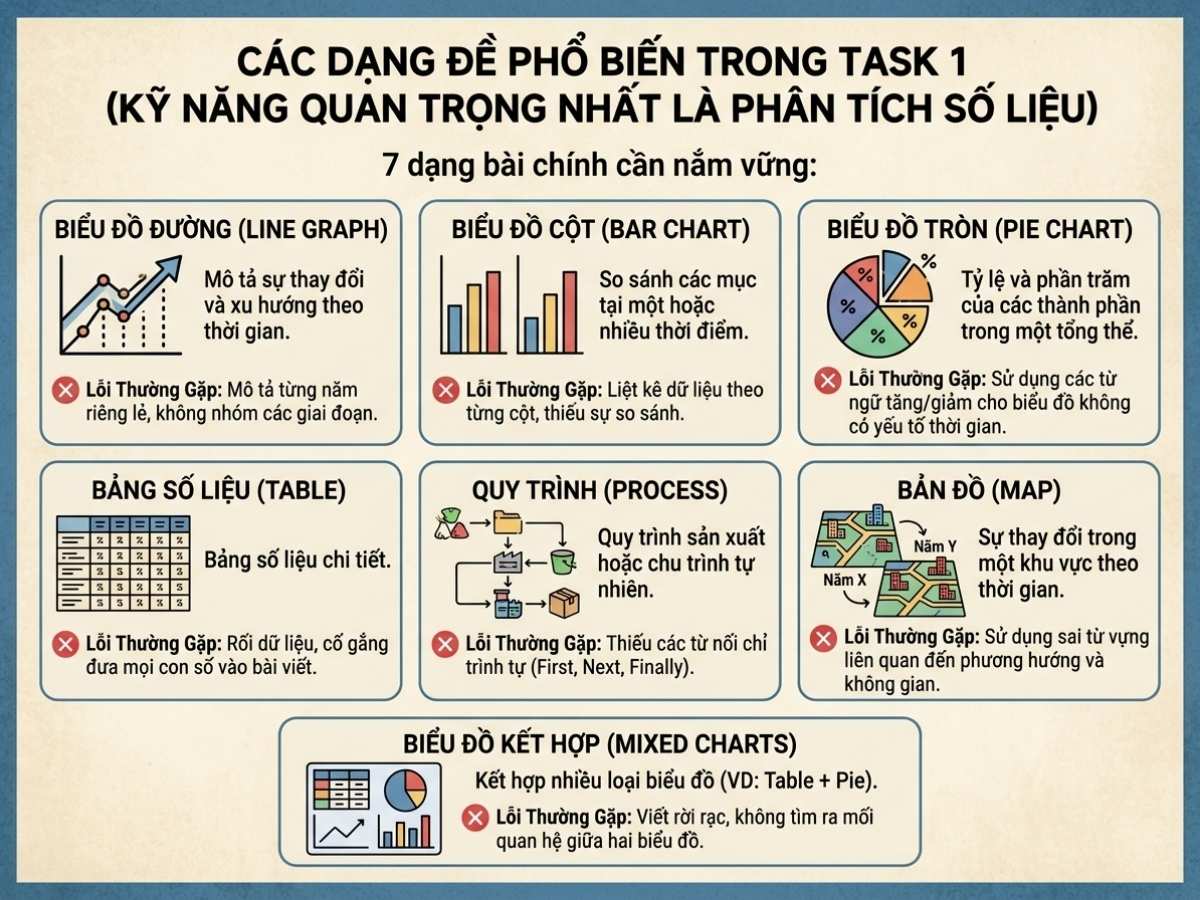
Các dạng đề thường gặp trong Task 1
3. Bố cục chuẩn 4 đoạn cho bài viết Task 1
Để bài viết mạch lạc và dễ chấm điểm, bạn nên tuân thủ cấu trúc 4 đoạn văn sau đây:
|
Đoạn
|
Vai trò chính
|
Số lượng câu lý tưởng
|
|
1. Introduction
|
Viết lại đề bài bằng ngôn ngữ của bạn (Paraphrase).
|
1 câu.
|
|
2. Overview
|
Nêu 2 đặc điểm nổi bật nhất (xu hướng chung, hạng mục cao nhất).
|
1 - 2 câu.
|
|
3. Body 1
|
Mô tả chi tiết và so sánh nhóm dữ liệu thứ nhất.
|
3 - 4 câu.
|
|
4. Body 2
|
Mô tả chi tiết và so sánh nhóm dữ liệu còn lại.
|
3 - 4 câu.
|
Lưu ý: Task 1 không cần đoạn Kết bài (Conclusion) vì phần Overview đã đóng vai trò tổng kết các đặc điểm chính. Việc viết thêm kết bài sẽ làm lãng phí thời gian quý giá cho Task 2
4. Quy trình 5 bước chinh phục Task 1 trong 20 phút
Bước 1 - Phân tích đề (1 phút): Xác định đối tượng biểu đồ, đơn vị đo lường và mốc thời gian để chọn thì động từ phù hợp.
Bước 2 - Tìm đặc điểm chính (2 phút): Khoanh vùng các điểm cao nhất, thấp nhất, điểm giao nhau hoặc sự thay đổi đột ngột.
Bước 3 - Viết Introduction (2 phút): Sử dụng các từ đồng nghĩa để viết lại đề bài (ví dụ: shows → illustrates/depicts).
Bước 4 - Viết Overview (3 phút): Nêu cái nhìn tổng quan. Hãy tự hỏi: "Điều gì nổi bật nhất khi nhìn lướt qua biểu đồ này?".
Bước 5 - Viết Body (12 phút): Nhóm dữ liệu (Data Grouping) thông minh dựa trên sự tương đồng về xu hướng hoặc mức độ để viết bài mạch lạc.
5. Cách sử dụng thì động từ chính xác
|
Mốc thời gian
|
Thì cần dùng
|
Ví dụ minh họa
|
|
Quá khứ
(Ví dụ: năm 2010)
|
Quá khứ đơn
|
The number of users increased significantly.
|
|
Hiện tại/Không mốc thời gian
|
Hiện tại đơn
|
The chart shows that the majority of people...
|
|
Tương lai (Dự báo)
|
Cấu trúc dự đoán
|
The figure is projected to reach a peak in 2030.
|
6. Các mẹo tăng điểm nhanh cho người mới bắt đầu
- Nguyên tắc vàng: Luôn nêu nhận xét/so sánh trước khi đưa ra số liệu minh họa đi kèm.
- Ưu tiên độ chính xác: Ở band 6.0 - 7.0, sự chính xác về ngữ pháp và số liệu quan trọng hơn việc cố gắng dùng những từ vựng quá cao siêu.
- Sử dụng từ nối: Sử dụng các từ chuyển ý như "In contrast", "Similarly", "By comparison" để bài viết liên kết chặt chẽ.
- Tránh lặp từ: Học các cụm từ mô tả xu hướng đa dạng (ví dụ: rise, climb, grow, go up).
- Luyện tập gõ phím: Sử dụng laptop để luyện viết giúp bạn quen với tốc độ và dễ dàng chỉnh sửa lỗi sai hơn.
7. Bài mẫu IELTS Writing Task 1 ngắn gọn
Dạng 1: Line Graph
Đề bài 1: The line graph shows the percentage of people using three types of transport in a city from 2000 to 2020.
Sample Report:
The line graph illustrates changes in the proportion of people using cars, buses and bicycles in a city between 2000 and 2020.
Overall, car use increased significantly and became the most common mode of transport. By contrast, bus use declined steadily, while cycling remained the least popular option despite a slight rise.
In 2000, buses were the most widely used form of transport at 50%, compared with 35% for cars and only 10% for bicycles. Over the next ten years, the figure for car users rose to 45%, overtaking buses, which fell to 40%.
By 2020, the proportion of car travelers reached 60%, the highest figure shown. Meanwhile, bus use dropped further to 30%, and cycling saw a modest increase to 15%.
Đề bài 2: Household Energy Consumption
Task: The line graph shows the average weekly energy consumption (in kilowatt-hours) of households in a country from 2010 to 2025.
Sample Report:
The line graph illustrates the average amount of energy consumed weekly by households in a specific country between 2010 and 2025.
Overall, there was a significant increase in total energy usage over the period. While electricity consumption rose sharply, the use of gas showed a steady decline after an initial peak.
In 2010, gas was the primary energy source at 80 kWh per week, while electricity started much lower at 40 kWh. By 2015, gas consumption reached its peak of 90 kWh before beginning a gradual downward trend. In contrast, electricity use grew consistently, overtaking gas in 2020 when both stood at approximately 75 kWh.
By 2025, electricity consumption is projected to reach its highest point at 100 kWh. Meanwhile, the figure for gas is expected to drop to 60 kWh, making it the secondary source of household energy.
Dạng 2: Bar Chart
Đề bài: The bar chart compares the number of minutes spent by people in the UK on three types of phone calls (Local, National/International, and Mobile) from 1995 to 2002.
Lưu ý: Tập trung so sánh sự chênh lệch giữa các cột thay vì liệt kê.
Sample Report:
The bar chart compares the duration of three different types of phone calls in the UK over an eight-year period.
Overall, local calls were consistently the most popular, although their usage began to decline toward the end. In contrast, both national/international and mobile calls saw steady growth throughout the period.
In 1995, local calls accounted for over 70 billion minutes, more than double the figure for national/international calls (38 billion) and significantly higher than mobile calls (only 3 billion). Local calls peaked at 90 billion minutes in 1999 before dropping back to their original 1995 level by 2002.
Meanwhile, national/international calls rose steadily to 60 billion minutes. The most dramatic growth was seen in mobile calls, which increased tenfold to reach approximately 45 billion minutes by the end of the period.
Dạng 3: Pie Chart
Đề bài: The two pie charts show the proportions of energy produced from different sources in a country in 1985 and 2005.
Lưu ý: Không dùng "tăng/giảm" nếu biểu đồ không có mốc thời gian (nhưng đề này có thời gian nên vẫn dùng được).
Sample Report:
The pie charts illustrate the changes in energy production from various sources in a specific country between 1985 and 2005.
Overall, coal remained the primary source of energy, while there was a significant shift toward renewable sources and nuclear power, reducing the reliance on oil.
In 1985, oil and coal were the dominant sources, accounting for 52% and 22% of total production respectively. By 2005, while coal’s share increased slightly to 25%, the use of oil dropped sharply to just 20%.
On the other hand, nuclear power saw its proportion double from 10% to 20% over the 20-year period. Similarly, renewable energy sources, which represented only 1% in 1985, grew significantly to 10% in 2005. Natural gas remained relatively stable, fluctuating slightly around the 15% mark.
Dạng 4: Table (Bảng số liệu)
Đề bài: The table below shows the percentage of the population in four countries who used the Internet between 1995 and 2010.
|
Country
|
1995
|
2000
|
2005
|
2010
|
|
USA
|
10%
|
45%
|
70%
|
85%
|
|
Canada
|
8%
|
40%
|
65%
|
80%
|
|
UK
|
5%
|
35%
|
60%
|
75%
|
|
Mexico
|
1%
|
5%
|
15%
|
35%
|
Sample Report:
The table presents the growth in internet usage as a percentage of the population in the USA, Canada, the UK, and Mexico from 1995 to 2010.
Overall, internet use increased dramatically in all four nations. The USA and Canada maintained the highest usage rates, while Mexico, despite rapid growth, remained the lowest.
In 1995, internet access was rare, with the USA leading at 10% and Mexico at only 1%. By 2005, the figures for the USA, Canada, and the UK had surged to between 60% and 70%. In the same year, Mexico’s usage reached 15%, a significant jump from its initial level.
By 2010, the USA had the highest proportion of users at 85%, followed closely by Canada at 80%. The UK reached 75%, while Mexico saw its most substantial increase in the final five years, ending at 35%.
Dạng 5: Process
Đề bài: The diagram shows the process of recycling glass bottles.
Lưu ý: Sử dụng câu bị động (Passive voice) và từ nối (First, Then, After that).
Sample Report:
The flow chart illustrates the stages involved in the recycling of used glass bottles.
Overall, the process consists of several steps, starting with the collection of waste glass and ending with the delivery of new glass products to consumers.
First, used glass bottles are gathered at collection points and transported to a recycling plant. Here, the glass is sorted by color (clear, green, or brown) and washed to remove any impurities. After cleaning, the glass is crushed into small pieces called cullet.
In the next stage, the cullet is mixed with raw materials like sand and soda ash, then melted in a high-temperature furnace. The molten glass is then shaped into new bottles using molds. Finally, these new bottles are filled with products and distributed to shops, ready to be purchased again.
Dạng 6: Map
Đề bài: The maps show the changes to a park from 1980 to the present day.
Lưu ý: Dùng giới từ chỉ phương hướng (To the north of, In the center).
Sample Report:
The maps compare the layout of a park in 1980 with its current design.
Overall, the park has been modernized with more facilities for visitors, although the main green areas have been reduced to make room for these additions.
In 1980, the park was quite simple, with a large pond in the center and trees scattered around the perimeter. There were only two gates, located to the north and south.
At present, the pond has been reduced in size to accommodate a new café and a children's play area in the center. To the west, the previously empty grass area has been converted into a car park. Additionally, a new cycle path has been built encircling the entire park, and the original trees have been replaced by flower beds near the entrances.
Dạng 7: Mixed Charts
Đề bài: The bar chart shows the number of visitors to a museum, and the pie chart shows their satisfaction levels.
Lưu ý: Chia 2 đoạn thân bài, mỗi đoạn mô tả một biểu đồ và tìm điểm liên kết.
Sample Report:
The bar chart illustrates the monthly number of visitors to a museum in 2010, while the pie chart displays the results of a visitor satisfaction survey.
Overall, the museum saw a peak in visitors during the summer months, and the majority of guests reported a positive experience.
According to the bar chart, visitor numbers started at 1,000 in January and rose steadily. The peak occurred in July and August, with over 5,000 visitors per month, before declining to 1,500 by December.
The pie chart shows that 75% of these visitors were either "Very Satisfied" (40%) or "Satisfied" (35%). In contrast, only 10% expressed dissatisfaction, while the remaining 15% were neutral. This suggests that despite the high volume of people during the summer, the museum managed to maintain a high quality of service.
8. Giải đáp thắc mắc thường gặp
Nên viết Task 1 hay Task 2 trước?
Thông thường bạn nên viết Task 1 trước để khởi động não bộ, nhưng hãy nhớ quản lý thời gian thật chặt chẽ trong 20 phút.
Có cần viết hết mọi con số có trong biểu đồ không?
Không. Bạn chỉ chọn lọc 2 - 3 đặc điểm nổi bật nhất để báo cáo và so sánh. Việc liệt kê quá nhiều số liệu sẽ khiến bài viết bị loãng và mất điểm tiêu chuẩn.
Viết câu đơn giản có đạt điểm cao không?
Có, nếu các câu đơn của bạn hoàn toàn chính xác về ngữ pháp và truyền tải thông tin logic. Tuy nhiên, hãy cố gắng kết hợp thêm các câu ghép để đạt band điểm cao hơn.
ĐỪNG BỎ LỠ các mẫu laptop giá tốt giảm sốc giúp học tiếng Anh dễ dàng hơn:
Để chinh phục IELTS Writing Task 1, chìa khóa chính là rèn luyện khả năng quan sát "bức tranh tổng thể" và biết cách nhóm thông tin hiệu quả. Hãy bắt đầu luyện tập với các dạng biểu đồ đường và cột trước khi thử sức với bản đồ hay quy trình nhé!
Bạn có làm được hướng dẫn này không?
 Có
Không
Có
Không

 Điện thoại
 Laptop
 Phụ kiện
 Smartwatch
 Đồng hồ
 Tablet
 Máy cũ, Thu cũ
 Màn hình, Máy in
 Sim, Thẻ cào
 Dịch vụ tiện ích























































 Xóa địa chỉ